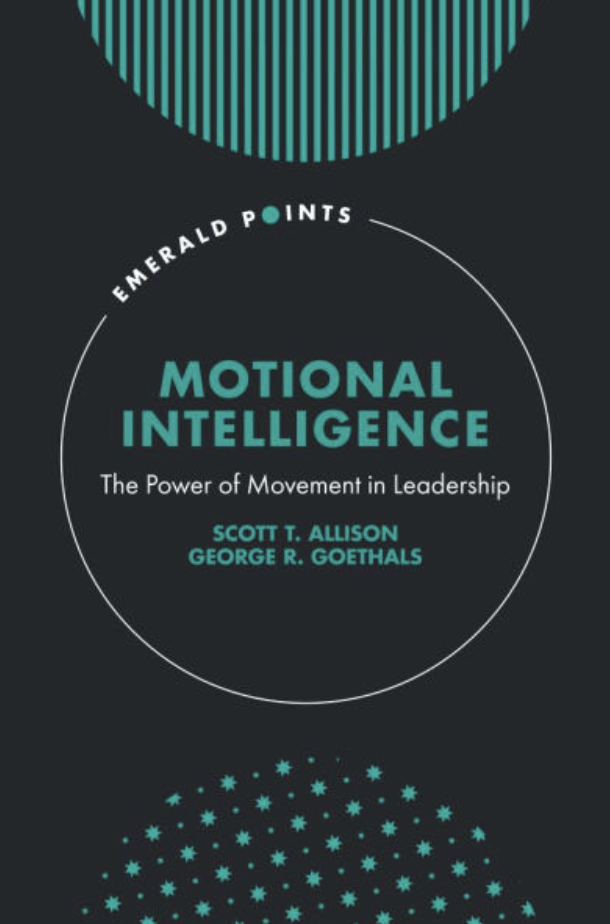
Our Latest Book: “Motional Intelligence: The Power of Movement in Leadership”

By Scott T. Allison

In 2026 we have released our new book on Motional Intelligence (MI) — a concept we believe fills a major gap in how we understand human interaction. MI refers to the ability to use body movement intentionally to influence others, to accurately read the movements of those around us, and to regulate our own physical behavior in shifting social situations. In short, it’s the intelligence of movement — the missing sibling of emotional intelligence.

Where emotional intelligence focuses on recognizing and managing feelings, MI centers on the moving body itself: posture, gesture, timing, rhythm, stillness, synchrony, and physical presence. It asks how movement shapes perception, connection, influence, and social meaning. And once you start paying attention to MI, you see it everywhere.

We form impressions of people long before they speak. Confidence, anxiety, warmth, dominance, awkwardness — we infer these qualities from motion: how someone enters a room, occupies space, approaches others, or carries themselves physically. Human beings are constant motion‑readers, often without realizing it.

Heroism, too, may depend heavily on MI. Before anyone is recognized as a hero, they are often first perceived as calm under pressure, physically decisive, emotionally grounded, or willing to step forward when others hesitate. Movement becomes the first visible signal of courage and agency.

Motional Intelligence explores this overlooked dimension of social life — and how understanding it can deepen our relationships, strengthen our leadership, and illuminate the subtle choreography of human connection.

Over Two Million People Have Visited This Heroes Blog

 People thirst for heroes. Back in 2010, on the eve of the release of our first book, Heroes: What They Do & Why We Need them, we decided to blog about them.

Little did we know that over 15 years later our heroes blog would be visited by over two million people. We’ve had visitors from all 50 states and over 260 countries.

The 20 nations who visit our blog most frequently are the U.S., Britain, Canada, France, Australia, the Philippines, India, Germany, Malaysia, Indonesia, Brazil, New Zealand, China, South Africa, Singapore, and Mexico.  We thank all of you for visiting us, leaving comments on our blog posts, and giving us helpful feedback and suggestions.

The top 10 U.S. states to visit us are, in order, California, Texas, New York, Virginia, Florida, Illinois, Pennsylvania, New Jersey, Georgia, and Ohio.

What is it about heroes that has us longing for them? Like this blog, heroism science is only a decade old, but we’re learning more and more about why the world hungers for heroes. A number of researchers have identified 12 functions of heroes:

  1. Heroes give us hope
  2. Heroes energize us
  3. Heroes develop us
  4. Heroes heal us
  5. Heroes impart wisdom
  6. Heroes are role models for morality
  7. Heroes offer safety and protection
  8. Heroes give us positive emotions
  9. Heroes give us meaning and purpose
  10. Heroes provide social connection and reduce loneliness
  11. Heroes help individuals achieve personal goals
  12. Heroes help society achieve societal goals

We’ve been studying heroes for many years and we’ve discovered many phenomena related to heroism. So please do suggest some names for us to profile, or issues for us to address in commentary pieces.  In the mean time, thanks so much for visiting us and for supporting today’s heroes.

Scott Allison and George Goethals, Professors Emeritus of Psychology and Leadership Studies

– – – – – – – – – – – – – – – – – – – – – – – – – – –


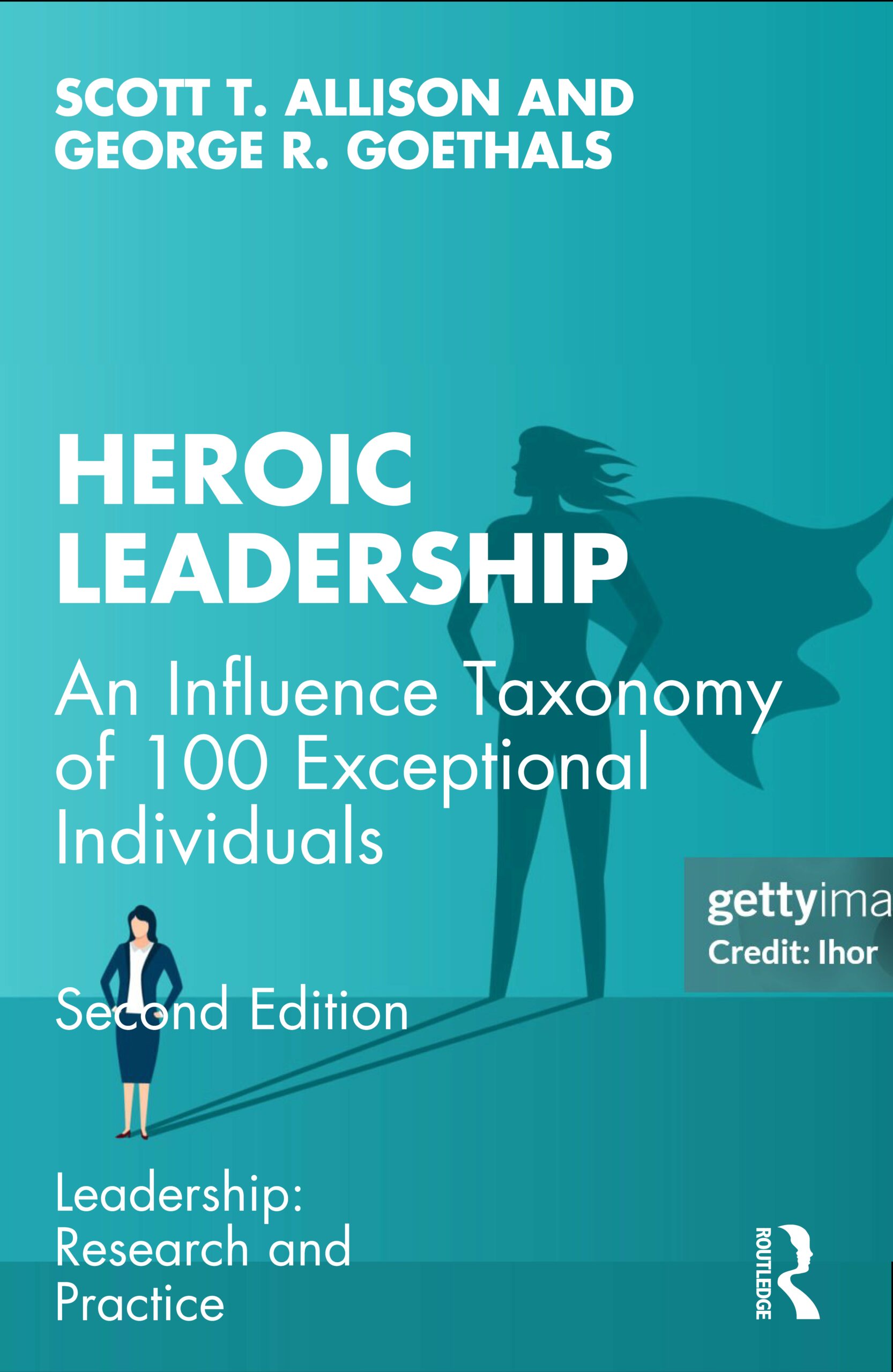
Second Edition of Our Second Book — “Heroic Leadership”

By Scott T. Allison and George R. Goethals

In this second edition of Heroic Leadership, we review the relationship between leadership and heroism, showing how our most cherished heroes are also our most transforming leaders.  We also describe in some detail a taxonomy, or conceptual framework, for differentiating among the many varieties of heroism.  Moreover, the book profiles many different individual heroes and provides an analysis of their heroic contributions.

Here’s what several distinguished reviewers have said about Heroic Leadership:

A pioneering and insightful examination of the intersection of heroes and leaders by two gifted psychologists.  Allison and Goethals’ captivating narrative  adds a new dimension to current research on leadership.”
JAMES MacGREGOR BURNS, Pulitzer Prize winning Professor Emeritus at Williams College and Distinguished Leadership Scholar at the James MacGregor Burns Academy of Leadership of the School of Public Policy at the University of Maryland.

* * * *

“Allison and Goethals’ stimulating and incisive survey of one-hundred influential leaders could not be more cogent or timely.  When so many of our leaders seem to have feet of clay and principles that bend with the prevailing breezes, they remind us of those leaders who rose to the occasion and stood firm in their moment of decision. As a result, they and their leadership have stood the test of time.  Heroic Leadership offers a refreshingly original and provocative perspective on what it means to be a great leader. Reading this book not only informs us, it also inspires!  My only suggestion would be that we expand their list to 102 — adding their names in appreciation of their heroic scholarly labors!”

RODERICK M. KRAMER, Professor of Organizational Behavior, Stanford University

* * * *

“Scott Allison and  George Goethals are pioneering scholars exploring the psychology of heroism and leadership, and this book outlines their contention that while all heroes are leaders, the converse is not true. They make their case by offering snapshots of 100 characters, some fictional (e.g., King Lear), some collective (e.g., Chilean miners, Power Rangers), and some surprising (e.g., Lady Gaga, Meryl Streep) who instantiate their taxonomy of heroes. For researchers and lay people alike, this book is packed with fascinating insights into the psychology of leadership, heroism, and mere celebrity. It is a book to be enjoyed by everyone who wonders why some people attract public attention, and others, who may deserve it (e.g., parents, soldiers, teachers) do not.”

DAVID M. MESSICK, Professor Emeritus at Northwestern University

* * * *

Presenting vivid accounts of distinguishable forms of heroism, this is a welcome contribution to understanding heroic aspects of leader-follower relations. It deserves a place as a text, reference source, and feast of revealing narratives. The accounts chosen capture what individuals’ special qualities underlie and activate others’ sense of the “heroic,” based on five factors affecting a leader’s influence. This yields ten types of heroes that are profiled, from trending and transitory to transforming and transcendent. Among those receiving attention in this cavalcade are the tragic, (Oedipus, Tiger Woods, Richard Nixon), and many shown as the “moral,” (e.g., The Dalai Lama, Mother Teresa, Rosa Parks). Insightful analyses of individual cases provide an illuminating blend of scientific scrutiny with compelling storytelling.

EDWIN P. HOLLANDER, Professor Emeritus, CUNY, Baruch College, and University Graduate Center

The Hidden Heroism of Human Movement

By Scott T. Allison

When we think about intelligence, we usually think about the mind. Intelligence is commonly associated with reasoning, memory, language, creativity, or emotional awareness. Yet one of the oldest and most powerful forms of human intelligence may reside not in words or abstract thought, but in movement itself.

Long before human beings developed spoken language, our ancestors communicated through posture, gesture, rhythm, pacing, and spatial orientation. A sudden movement could warn of danger. A calm posture could reassure others. A coordinated group movement could signal trust, unity, and shared purpose. Human beings moved meaningfully before they spoke meaningfully.

My colleague George Goethals and I use the term Motional Intelligence (MI) to describe this overlooked dimension of social life. MI refers to the ability to use body movement intentionally to influence others, to accurately interpret the movements of other people, and to regulate one’s own bodily behavior in response to changing social situations. In short, MI is the intelligence of movement in human interaction.

This idea differs from emotional intelligence, which focuses primarily on recognizing and managing emotions. MI centers on the moving body itself—on posture, gesture, timing, rhythm, stillness, synchrony, and physical presence. It asks how movement shapes perception, connection, influence, and social meaning.

Once you begin paying attention to MI, you see it everywhere.

Think about how quickly we form impressions of people. Before anyone says a word, we often sense whether someone appears confident, anxious, trustworthy, dominant, warm, awkward, or emotionally withdrawn. We infer these qualities from movement: how a person enters a room, occupies space, approaches others, or carries themselves physically. Human beings constantly read one another through motion, often unconsciously.

Heroism itself may depend heavily on MI. Before people are recognized as heroes, they are often first perceived as calm under pressure, physically decisive, emotionally grounded, or capable of stepping forward when others hesitate. Movement frequently serves as the first visible signal of courage and agency.

Film offers striking examples. Some of cinema’s most memorable characters communicate more through movement than dialogue. Charlie Chaplin’s Tramp expresses vulnerability and compassion almost entirely through physical timing and gesture. Humphrey Bogart’s Rick Blaine in Casablanca projects emotional restraint through stillness and minimal movement. Heath Ledger’s Joker in The Dark Knight unsettles viewers through erratic pacing, invasive proximity, and unpredictable bodily rhythms. Their movements communicate psychological depth before words ever do.

Politics and leadership reveal similar dynamics. During the 2016 U.S. presidential debates, one of the most memorable moments involved not policy but movement. Donald Trump paced closely behind Hillary Clinton while she spoke, and viewers interpreted the same physical behavior in dramatically different ways—some seeing dominance and confidence, others perceiving intimidation and intrusion. The moment illustrated how bodily motion can shape emotional climates and public interpretation as powerfully as spoken language.

But MI is not limited to leaders, actors, or charismatic personalities. It permeates everyday life. Long-married couples often move in subtle synchrony, anticipating each other’s actions almost unconsciously. Friends walking together gradually align their pace. Parents instinctively soothe distressed children through rhythmic rocking and calming physical presence. Human relationships are constantly choreographed through movement.

Importantly, MI is probably not a fixed talent reserved for a gifted few. Like many forms of intelligence, it can likely be strengthened through awareness and practice. People can learn to become more attentive to bodily signals, more skillful in regulating tension through posture and pacing, and more accurate in interpreting the movements of others.

In an increasingly digital world, this may matter more than ever. Texting, email, and online communication strip away much of the movement information our brains evolved to process. Yet even advanced technologies—from virtual reality to social robotics—are discovering that believable movement remains essential to creating trust, connection, and emotional realism.

Perhaps this is the deeper lesson of motional intelligence: human beings do not merely think and speak their way through social life. We move our way through it. And learning to move with greater awareness, empathy, and responsibility may become one of the most important human capacities of the future.

References

Allison, S. T., & Goethals, G. R. (2026). Motional intelligence: The power of movement in leadership. Emerald.

= = = = = = = = = = = =

The Missing Story: Why We Still Need a Shared Hero Narrative

By Scott T. Allison

If you step back and look at modern life, something feels off. We are more connected than ever, yet less unified. Stories surround us—streaming endlessly across screens—yet the kinds of shared narratives that once brought people together seem harder to find .

So what changed?

To be sure, no society has ever been perfectly unified. People have always disagreed, and cultures have always contained competing ideas. But many earlier societies did share broad narrative frameworks—religious, moral, and mythological—that helped people make sense of life.

These stories provided a kind of common language, helping answer enduring questions: Who are we? What matters? How should we live?

Over time, scholars have argued that this shared narrative ground has weakened. The sociologist Émile Durkheim warned that modern societies risk falling into anomie when shared values erode. Max Weber described an “age of disenchantment,” where scientific rationality strips the world of mystery and meaning. More recently, thinkers like Charles Taylor have suggested that while people still search for purpose, they often do so alone, without a shared framework to guide them.

But the problem is not that we lack stories. In fact, we are surrounded by them—superheroes, political identities, cultural narratives, and personal stories shaped online. The real issue is fragmentation. We have many stories, but fewer that we hold in common.

That distinction matters.

In earlier cultures, shared myths often acted as social glue. They offered not just entertainment, but a sense of belonging and direction—a narrative map of human experience. Today, that map is harder to locate.

This is where Joseph Campbell’s work becomes especially relevant. After studying myths across cultures, Campbell identified a recurring pattern he called the Hero’s Journey. In this story, an ordinary person is called to adventure, faces challenges, grows through struggle, and returns to serve others.

Campbell believed this pattern resonates because it reflects something fundamental about being human: we all face obstacles, we all change, and we all have the potential to contribute.

Of course, not every culture fits neatly into this framework. Some traditions emphasize community over individual heroes, or cyclical rather than linear stories. But even with these differences, the Hero’s Journey captures a widely recognizable pattern—one that continues to show up across time and place.

So what role might it play today?

While we may no longer share a single mythology, we can still share a common structure of meaning. The Hero’s Journey doesn’t tell us what to believe. Instead, it offers a flexible framework for understanding how growth unfolds—through challenge, courage, and transformation.

In that sense, it can serve as a kind of shared narrative grammar in a diverse world. Without something like this, it becomes harder to talk about purpose, growth, and responsibility. We risk living in separate narrative worlds, each with its own logic and values.

The Hero’s Journey offers a bridge.

It reminds us that struggle is part of life, that growth requires stepping into uncertainty, and that our journeys are not just about ourselves. At its best, it is not a story of personal triumph alone, but of return—of using what we’ve gained to help others.

This is where the idea becomes practical.

We can introduce the Hero’s Journey at home, helping children see challenges as opportunities for growth. Schools can use it to support resilience and identity development. Faith communities can connect it to traditions of transformation and service. Even organizations can use it to frame leadership and purpose.

This is not about imposing a single worldview. It is about offering a shared lens—one that is flexible enough to include many perspectives, yet structured enough to create common ground.

Because beneath our differences, we all face moments that call us forward—moments that ask us to grow, to act, and to contribute.

Perhaps myths have not disappeared. Perhaps we have simply lost sight of the patterns that still connect us.

The Hero’s Journey reminds us that even in a fragmented world, there remains a shared rhythm to human life: challenge, transformation, and return. It is not the only story we need—but it may be one of the few that can still bring us together.

And in a divided world, that may matter more than ever.

References

Allison, S. T. (2024). Hero Monomyth. In S. T. Allison, J. K. Beggan, and G. R. Goethals (Eds.), Encyclopedia of Heroism Studies. Springer.

= = = = = = = = =

Our New Book — Everyday Heroism: Courage, Compassion and the Power to Change the World

By Scott T. Allison

I’ve spent the past year co‑editing a new academic volume called Everyday Heroism: Courage, Compassion and the Power to Change the World, soon to be published by Cambridge Scholars. It’s been loads of fun working with my two co-editors Joanna Pascoe and Theresa Thorhildsen — both of these colleagues also happen to co-edit the Heroism Science journal with me.

Somewhere along the way I realized that this new Everyday Heroism book addresses something I’ve been circling for years: the idea that heroism isn’t a rare, cinematic event but a daily practice—quiet, improvised, and often unnoticed. The contributors to this volume come from psychology, education, and literary studies, and they all converge on a simple but powerful insight: ordinary people routinely meet challenge, risk, and uncertainty with courage and care. We just don’t always recognize it as heroism.

One of the joys of working on this book has been seeing how differently scholars and practitioners approach the same core question: How does heroic action emerge in everyday life? Some look to classrooms, where teachers model moral courage in the small decisions that shape a child’s sense of safety and possibility. Others turn to community settings, where people respond to adversity not with grand gestures but with steady, prosocial action—checking on a neighbor, stepping into a conflict, or offering support when it’s least convenient. Still others examine the stories we tell in literature and popular media, tracing how cultural narratives shape our sense of what courage looks like and who gets to be seen as a hero.

The book doesn’t shy away from the harder edges of heroism either. Several chapters explore the ethical tensions that arise when good intentions collide with complex realities. Others examine failure—what it means when heroic efforts fall short, and how people make sense of those moments. And a few contributors take up the role of the antihero, showing how flawed or reluctant figures can illuminate the messy, ambiguous terrain of real-world moral action.

What makes this collection especially energizing is its international scope. Authors from Europe, Oceania, and North America bring perspectives shaped by different cultural contexts, different educational systems, and different social challenges. Yet across these differences, a shared theme emerges: heroism is less about extraordinary individuals and more about the everyday choices that sustain communities and foster resilience.

If you’re interested in leadership, moral courage, or simply understanding how people rise to meet the demands of the twenty‑first century, I think you’ll find something meaningful in this volume. Editing it reminded me that heroism isn’t a distant ideal. It’s something we practice—imperfectly, creatively, persistently—every day.

I’ll keep you updated about the book’s publication date, which is probably late 2026. Here’s the exact citation:

Pascoe, J., Thorkhildsen, T., & Allison, S. T. (2027). Everyday heroism: Courage, compassion and the power to change the world. Cambridge Scholars.

= = = = = = = =